Viewing docs for iterative 0.11.20
published on Monday, Apr 14, 2025 by iterative
published on Monday, Apr 14, 2025 by iterative
Iterative Provider
I want to use the Pulumi iterative package (iterative) in my project.
## Provider details
- Package: iterative
- Version: 0.11.20
- Publisher: iterative
- Source: opentofu
- Repository: https://github.com/iterative/terraform-provider-iterative
## Documentation
The Pulumi Cloud Registry API serves canonical, up-to-date docs for this package — including private packages and every published version. Send the "Accept: text/markdown" header for clean readable content, or "application/json" for structured data.
Start at the navigation tree, which cross-links to the readme, installation guide, and per-resource docs URL template:
- https://api.pulumi.com/api/registry/packages/opentofu/iterative/iterative/versions/latest/nav
Returns a summary by default. The full tree can be hundreds of kB for large providers, so prefer targeted search: append "?q=<query>&depth=full" to filter by resource/function title or token (for example "?q=bucket&depth=full"). Only request the full nav without a query if you actually need to enumerate every resource.
Other endpoints:
- Overview and getting started: https://api.pulumi.com/api/registry/packages/opentofu/iterative/iterative/versions/latest/readme
- Installation and configuration: https://api.pulumi.com/api/registry/packages/opentofu/iterative/iterative/versions/latest/installation
- Per-resource/function docs: https://api.pulumi.com/api/registry/packages/opentofu/iterative/iterative/versions/latest/docs/{token}?lang={lang}
Replace {token} with the percent-encoded token from the nav response (for example aws:s3/bucket:Bucket).
Replace {lang} with typescript, python, go, csharp, java, or yaml.
Fetch the installation endpoint above for the correct setup steps — install instructions vary between native providers, bridged Terraform providers, and component packages.
Help me get started using this provider. Show me a complete Pulumi program that provisions a common resource, including all necessary configuration and imports.
Viewing docs for iterative 0.11.20
published on Monday, Apr 14, 2025 by iterative
published on Monday, Apr 14, 2025 by iterative
Generate Provider
The Iterative provider must be installed as a Local Package by following the instructions for Any Terraform Provider:
pulumi package add terraform-provider iterative/iterative
Overview


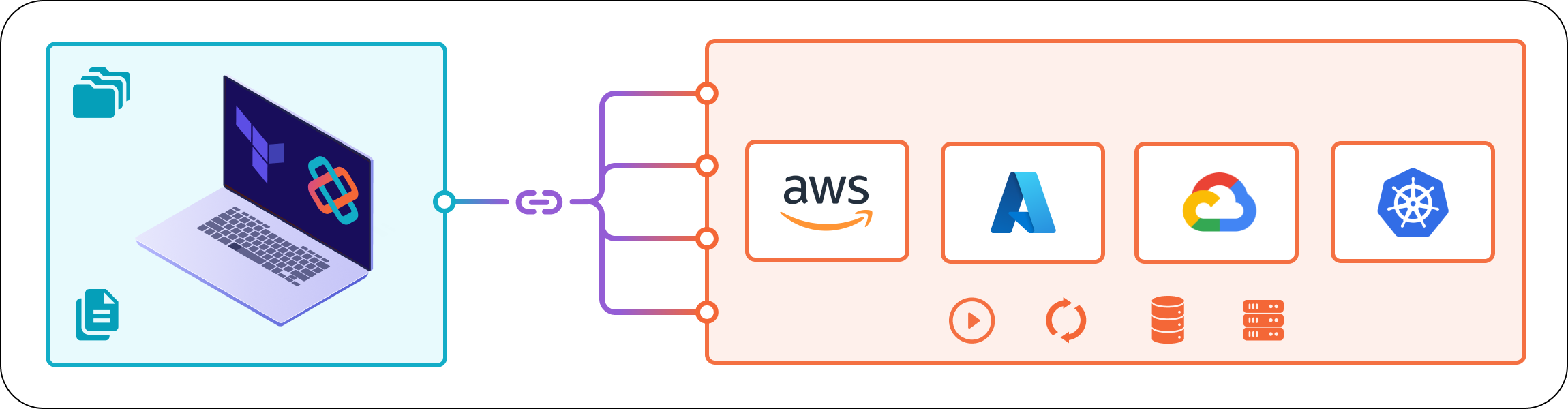
TPI is a Pulumi plugin built with machine learning in mind. This CLI tool offers full lifecycle management of computing resources (including GPUs and respawning spot instances) from several cloud vendors (AWS, Azure, GCP, K8s)… without needing to be a cloud expert.
- Lower cost with spot recovery: transparent data checkpoint/restore & auto-respawning of low-cost spot/preemptible instances
- No cloud vendor lock-in: switch between clouds with just one line thanks to unified abstraction
- No waste: auto-cleanup unused resources (terminate compute instances upon task completion/failure & remove storage upon download of results), pay only for what you use
- Developer-first experience: one-command data sync & code execution with no external server, making the cloud feel like a laptop
Supported cloud vendors include:
| 
Why TPI?
There are a several reasons to use TPI instead of other related solutions (custom scripts and/or cloud orchestrators):
- Reduced management overhead and infrastructure cost: TPI is a CLI tool, not a running service. It requires no additional orchestrating machine (control plane/head nodes) to schedule/recover/terminate instances. Instead, TPI runs (spot) instances via cloud-native scaling groups (AWS Auto Scaling Groups, Azure VM Scale Sets, GCP managed instance groups, and Kubernetes Jobs), taking care of recovery and termination automatically on the cloud provider’s side. This design reduces management overhead & infrastructure costs. You can close your laptop while cloud tasks are running – auto-recovery happens even if you are offline.
- Unified tool for data science and software development teams: TPI provides consistent tooling for both data scientists and DevOps engineers, improving cross-team collaboration. This simplifies compute management to a single config file, and reduces time to deliver ML models into production.
- Reproducible, codified environments: Store hardware requirements in a single configuration file alongside the rest of your ML pipeline code.
 TPI is used to power CML, bringing cloud providers to existing GitHub, GitLab & Bitbucket CI/CD workflows (repository).
Links
- Getting Started
- Full reference
- Example Projects
Viewing docs for iterative 0.11.20
published on Monday, Apr 14, 2025 by iterative
published on Monday, Apr 14, 2025 by iterative