


Google Cloud Serverless Application
Available in TypeScript, Python, Go, C#, YAML, HCL
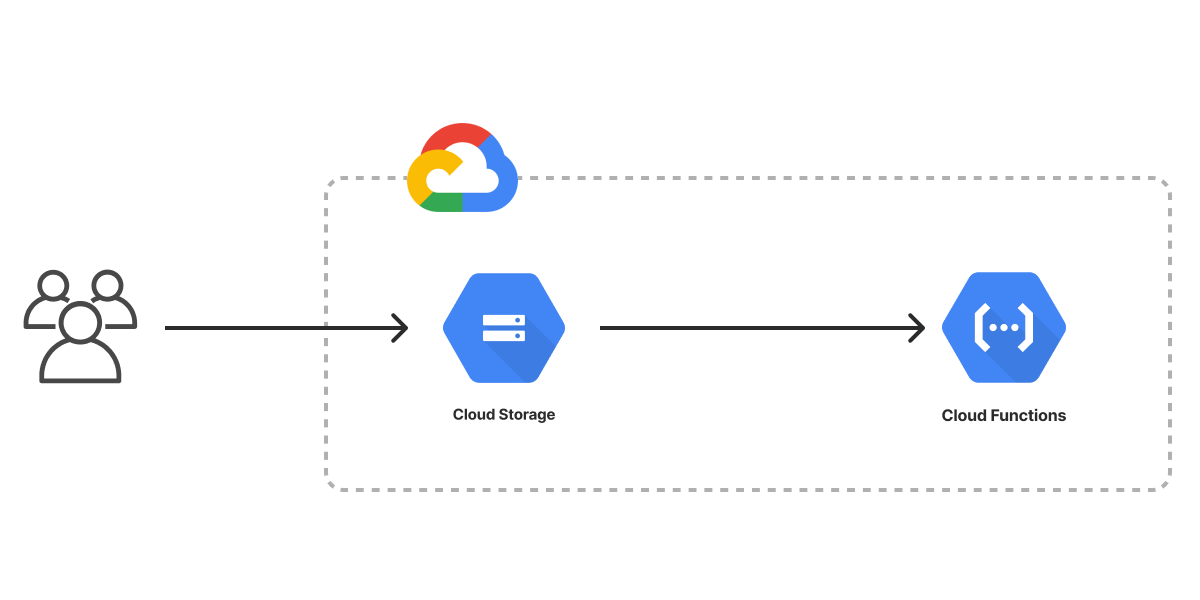
The Google Cloud Serverless Application template scaffolds a Pulumi project that deploys a Google Cloud Storage bucket configured for static website hosting and a Cloud Functions Gen 2 function for the application backend. The template ships with placeholder web and function content so the project deploys end to end out of the box.
Before you deploy
Cloud Functions Gen 2 functions are gated at the underlying Cloud Run service, so the public-invoker grant in this template is created with gcp.cloudrun.IamMember (roles/run.invoker). The identity running pulumi up needs to be able to set IAM policy on Cloud Run — typically roles/run.admin, or a custom role that includes run.services.setIamPolicy — in addition to the permissions needed to create the function and storage resources.
Using this template
To use this template to deploy your own serverless application, make sure you’ve installed Pulumi and configured your Google Cloud credentials, then create a new project using the template in the language of your choice:
$ mkdir my-serverless-app && cd my-serverless-app
$ pulumi new serverless-gcp-typescript

$ mkdir my-serverless-app && cd my-serverless-app
$ pulumi new serverless-gcp-python
$ mkdir my-serverless-app && cd my-serverless-app
$ pulumi new serverless-gcp-go
$ mkdir my-serverless-app && cd my-serverless-app
$ pulumi new serverless-gcp-csharp
$ mkdir my-serverless-app && cd my-serverless-app
$ pulumi new serverless-gcp-yaml
$ mkdir my-serverless-app && cd my-serverless-app
$ pulumi new serverless-gcp-hcl
Follow the prompts to complete the new-project wizard. When it’s done, you’ll have a complete Pulumi project that’s ready to deploy and configured with the most common settings. Feel free to inspect the code in index.jsindex.ts__main__.pymain.goProgram.csProgram.fsProgram.vbApp.javaPulumi.yamlmain.tf
Deploying the project
The template requires no additional configuration. Once the new project is created, you can deploy it immediately with pulumi up:
$ pulumi up
When the deployment completes, Pulumi exports the following stack output values:
- siteURL
- The HTTP URL of the static website.
- apiURL
- The HTTP URL of the serverless function endpoint.
- site_url
- The HTTP URL of the static website.
- api_url
- The HTTP URL of the serverless function endpoint.
Output values like these are useful in many ways, most commonly as inputs for other stacks or related cloud resources. The computed site URL, for example, can be used from the command line to open the newly deployed website in your favorite web browser:
$ open $(pulumi stack output siteURL)
$ open $(pulumi stack output site_url)
Customizing the project
Projects created with the serverless template expose the following configuration settings:
- sitePath
- The path to the folder containing the files of the website. Defaults to
www, which is the name (and relative path) of the folder included with the template. - appPath
- The path to the folder containing the serverless functions to be deployed. Defaults to
app, which is also included with the template. - indexDocument
- The file to use for top-level pages. Defaults to
index.html. - errorDocument
- The file to use for error pages. Defaults to
error.html.
- region
- The Google Cloud region to deploy into. Defaults to
us-central1. - site_path
- The path to the folder containing the files of the website. Defaults to
./www, which is the relative path of the folder included with the template. - app_path
- The path to the folder containing the serverless functions to be deployed. Defaults to
./app, which is also included with the template. - index_document
- The file to use for top-level pages. Defaults to
index.html. - error_document
- The file to use for error pages. Defaults to
error.html.
All of these settings are optional and may be adjusted either by editing the stack configuration file directly (by default, Pulumi.dev.yaml) or by changing their values with pulumi config set:
$ pulumi config set sitePath ../my-existing-website/build
$ pulumi up
$ pulumi config set site_path ../my-existing-website/build
$ pulumi up
Cleaning up
You can cleanly destroy the stack and all of its infrastructure with pulumi destroy:
$ pulumi destroy
Learn more
- Browse other architecture templates in the Templates gallery.
- Explore the Google Cloud provider API docs in the Pulumi Registry.
- Walk through Pulumi from the ground up in Pulumi Tutorials.
- Read the latest Google Cloud posts on the Pulumi blog.