Component Usage Tracking in Pulumi Private Registry
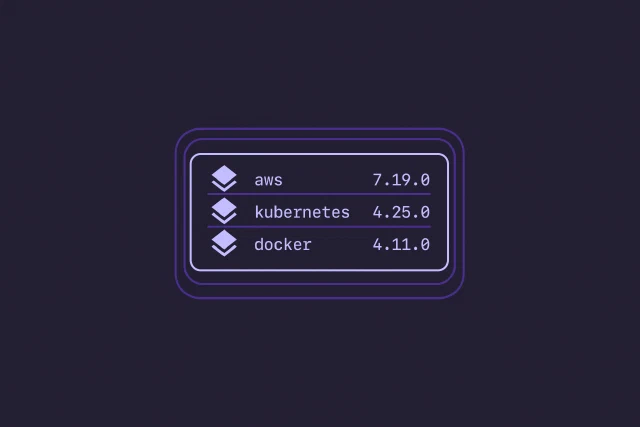
Platform teams publishing components to the Pulumi Private Registry can now see exactly which stacks are using each component and at which version.

Welcome to the fourth post in our IDP Best Practices series. Today we’re diving into the world of drift detection and remediation, those critical day 2 operations that keep your infrastructure aligned with its intended configuration long after the initial deployment.
You’ve built a beautiful platform with robust guardrails, comprehensive templates, and well-defined golden paths. Your developers are productive, deployments are smooth, and everything seems perfect. Then reality hits. An on-call engineer makes an emergency change through the AWS console during a 3 AM incident. A team member tweaks a security group rule to debug a connection issue and forgets to revert it. Auto-scaling adjusts capacity based on load patterns. Before you know it, your actual infrastructure has quietly diverged from what your code describes.

Welcome to the third post in our IDP Best Practices series, where we explore how to implement policy as code with Pulumi CrossGuard to create deployment guardrails that make self-service infrastructure both powerful and safe.
Platform engineering presents a fundamental tension: we want to enable developer velocity while maintaining security and compliance. Every platform team faces the same question: how do you give teams the freedom to deploy infrastructure quickly without compromising on safety, security, or organizational standards? The answer isn’t to choose between speed and safety, but rather to embrace automated guardrails powered by policy as code that make both possible simultaneously.

Building and maintaining reusable infrastructure has always been about more than just writing good code. It’s about making that code discoverable, understandable, and easy to adopt across your organization. Today, we’re excited to announce a new feature that removes significant friction from sharing and consuming infrastructure components: automatic multi-language API documentation in Pulumi Private Registry.

As part of the Pulumi IDP announcement at PulumiUP, we introduced the Pulumi Private Registry. For years, we’ve worked with organizations that have built their own internal developer platforms on top of Pulumi. During that time, we identified what we believe is the best method for creating flexible golden paths – a bottom-up approach that utilizes a central source of truth to drive golden paths. Thanks to Pulumi Private Registry, this approach has never been simpler.

Today, we’re excited to introduce Pulumi IDP (Internal Developer Platform), the latest evolution of the Pulumi Cloud Platform, designed to help organizations automate, secure, and manage everything they run in the cloud.