Posts Tagged pulumi-neo

AI Predictions for 2026: A DevOps Engineer's Guide
AI Predictions for 2026: A DevOps Engineer's Guide

The IDE is dying, and so is tool calling. OpenAI is not going to win. And next year, you’re going to be shipping code that you’ve never reviewed before, even as an experienced engineer.

These are bold claims, but the way we use AI in 2026 for coding and agents is going to look completely different. In this post, I want to cover my predictions and why they matter right now for DevOps engineers. Some of these are definitely hot takes, but that’s what makes this conversation worth having.
Read more →

Encode What You Know With Neo: Custom Instructions and Slash Commands

Encode What You Know With Neo: Custom Instructions and Slash Commands

Every organization builds up knowledge over time: naming standards, compliance requirements, patterns your team has settled on, and proven approaches to common tasks. Until now, bringing this knowledge into Neo meant repeating it manually each time - specifying preferences, describing how your team works, and recreating prompts that someone already perfected.

Two new features change this. Custom Instructions teach Neo your standards so it applies them automatically. Slash Commands capture proven prompts so anyone on your team can use them with a keystroke.

Read more →

Beyond YAML in Kubernetes: The 2026 Automation Era

Beyond YAML in Kubernetes: The 2026 Automation Era

Kubernetes continues to evolve, powering not only applications but entire AI and ML systems across clouds, edges, and enterprises. By 2026, DevOps engineers, SREs, cloud engineers, and platform teams face growing pressure to deliver faster, smarter, and more secure infrastructure at scale.

Kubernetes automation is entering a new era where infrastructure as code, policy enforcement, and AI-driven orchestration work together to manage cloud environments intelligently.

Pulumi’s 2025 advancements, including Pulumi Kubernetes Operator 2.0 GA, new Kubernetes best practices playbooks, Pulumi Neo for AI assisted infrastructure management, and Policy Automation, set the foundation for a new era of Kubernetes automation that extends across every role involved in managing modern infrastructure.

Read more →

Announcing the Next Generation of Pulumi Policies: AI-Accelerated Governance for the Cloud

Announcing the Next Generation of Pulumi Policies: AI-Accelerated Governance for the Cloud

The era of AI-accelerated development has created a paradox: the faster developers move, the bigger the governance challenge becomes. For years, security and platform teams have worked to “shift left,” but the tools available have been incomplete. Most focus on detection, which is necessary but not sufficient. They identify thousands of policy violations across an organization’s infrastructure but leave teams with an overwhelming backlog and no scalable way to remediate it. This creates a persistent gap between finding a problem and fixing it. The result is an impossible choice between development velocity and organizational control, forcing leadership to slow down innovation to manage risk.

Today, we end that compromise.

Read more →

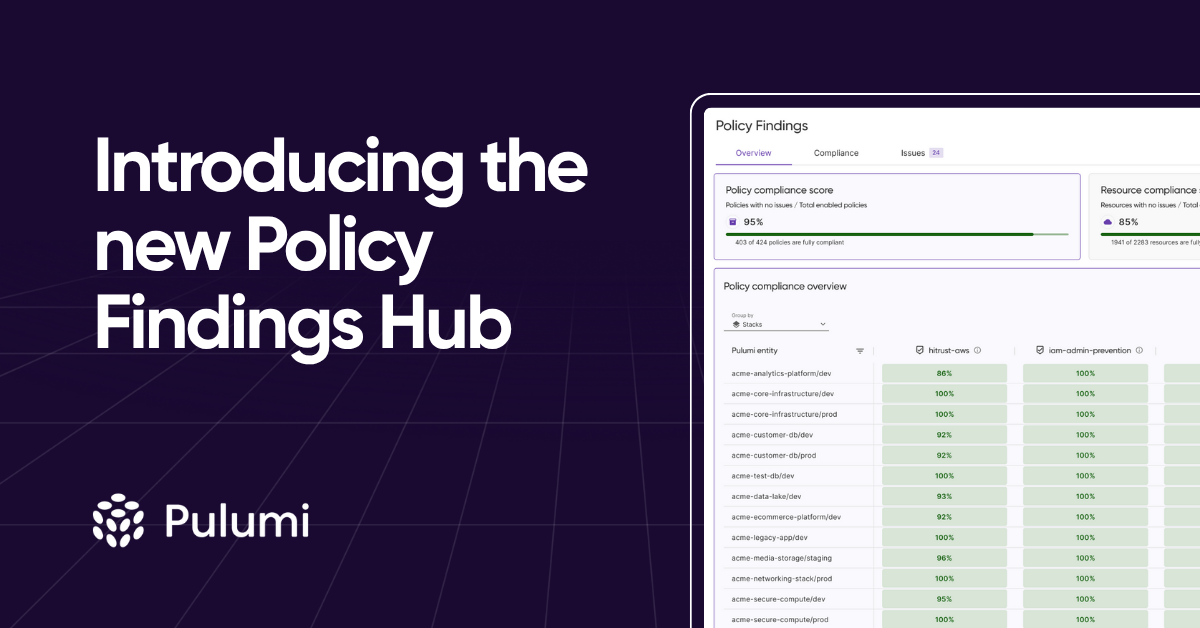
Policy Findings Hub: Move From Alert Fatigue to Action

Policy Findings Hub: Move From Alert Fatigue to Action

For platform and security teams, enabling robust cloud scanning often creates a new problem: an unmanageable firehose of policy alerts. Identifying a violation is only the first step. Without a system to manage the lifecycle of these findings, teams are quickly overwhelmed, leading to prioritization paralysis and a perpetually growing backlog.

The Policy Findings hub in Pulumi Cloud is the solution to this alert fatigue. It’s a purpose-built, collaborative workspace that turns a noisy list of violations into organized, actionable tasks. The hub brings clarity and structure to the compliance process, guiding teams from initial discovery to a verified fix.

Read more →

Grounded AI: Why Neo Knows Your Infrastructure

Grounded AI: Why Neo Knows Your Infrastructure

Ask a generic LLM to “fix my broken deployment,” and you’ll get generic advice. Ask Pulumi Neo the same question, and you’ll get a fix plan grounded in your actual infrastructure state.

The difference isn’t about better prompts or newer models. It’s about what the AI actually knows. Generic LLMs have been trained on the internet. Neo has been trained on your infrastructure.

Read more →

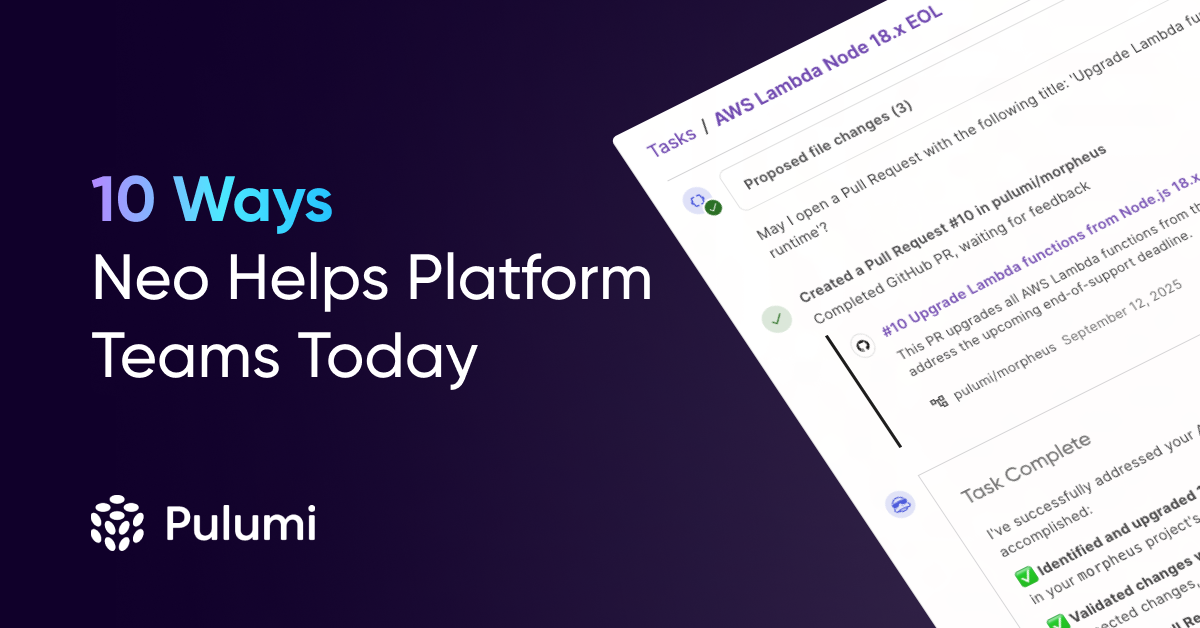
10 Things You Can Do With Our Infrastructure Agent, Neo

10 Things You Can Do With Our Infrastructure Agent, Neo

Since launching Pulumi Neo two weeks ago, we’ve seen platform teams discover creative ways to put their newest AI teammate to work. We have also been using Neo internally for a handful of use cases. Neo shifts the conversation from “what could AI do for infrastructure?” to “what can I actually accomplish with Neo today?”

The answer is quite a bit. Here are 10 concrete workflows that platform teams can use Neo for right now, each one designed to save hours of manual work while keeping humans in the driver seat.

Read more →

Policy Comes to Team and Enterprise, with New Out-of-the-box Policies and Management Experience

Policy Comes to Team and Enterprise, with New Out-of-the-box Policies and Management Experience

Pulumi’s Infrastructure as Code has included a powerful policy engine from day one. Over the past year, we’ve been enhancing it significantly to provide stronger governance for modern cloud platforms. Until now, these capabilities were limited to our Business Critical tier. Today, we’re excited to announce that policy guardrails are now available to all Team and Enterprise customers. Alongside this, we’re launching a redesigned policy management experience and introducing out-of-the-box policy packs that make it easier than ever to secure, govern, and optimize your cloud environments—even when powered by AI agents like Pulumi Neo.

Read more →

Meet Neo, Your Newest Platform Engineer

Meet Neo, Your Newest Platform Engineer

AI coding assistants have transformed the speed at which developers can write and deploy code. Pull request velocity has increased significantly. Feature delivery has accelerated beyond what we thought possible just two years ago. This should be a victory for everyone in the software organization.

Instead, it’s created significant challenges for infrastructure and platform teams.

Read more →