Tom Harding

Tom Harding

Software Engineer

New in Pulumi IaC: `onError` Resource Hook

New in Pulumi IaC: `onError` Resource Hook

You can now control what happens when a resource fails during create, update, or delete—retry with backoff, fail fast, or handle errors in custom code. Last year, Pulumi IaC introduced the resource hooks feature, allowing you to run custom code at different points in the lifecycle of resources. Today we’re adding the onError hook so you can react when operations fail.

Read more →

New in Pulumi IaC: `replacementTrigger` Resource Option

New in Pulumi IaC: `replacementTrigger` Resource Option

Pulumi IaC gives us a declarative interface to updates. When we perform an update, Pulumi calculates the difference between your currently deployed infrastructure and what is being proposed, then deploys only what is required to migrate from the old state to the new state. Normally, this is exactly what we want: we minimize the amount of work required to perform the update, and don’t recreate anything unnecessarily. However, every now and then, we want to override this behavior.

Read more →

New in Pulumi IaC: `replaceWith` Resource Option

New in Pulumi IaC: `replaceWith` Resource Option

The magic of Pulumi is that we rarely have to worry about the fine details of how our deployment and infrastructure management works, allowing us to focus instead on what we want. If our program declares an S3 bucket, Pulumi handles creation, updates, and deletion automatically.

Most of the time, this is exactly what we want. However, some use cases require finer-grained control over resource dependencies. Today, we’re introducing the replaceWith resource option, a new feature that gives you explicit control over replacement dependencies between resources.

Read more →

New in Pulumi IaC: Support for skipping a resource

New in Pulumi IaC: Support for skipping a resource

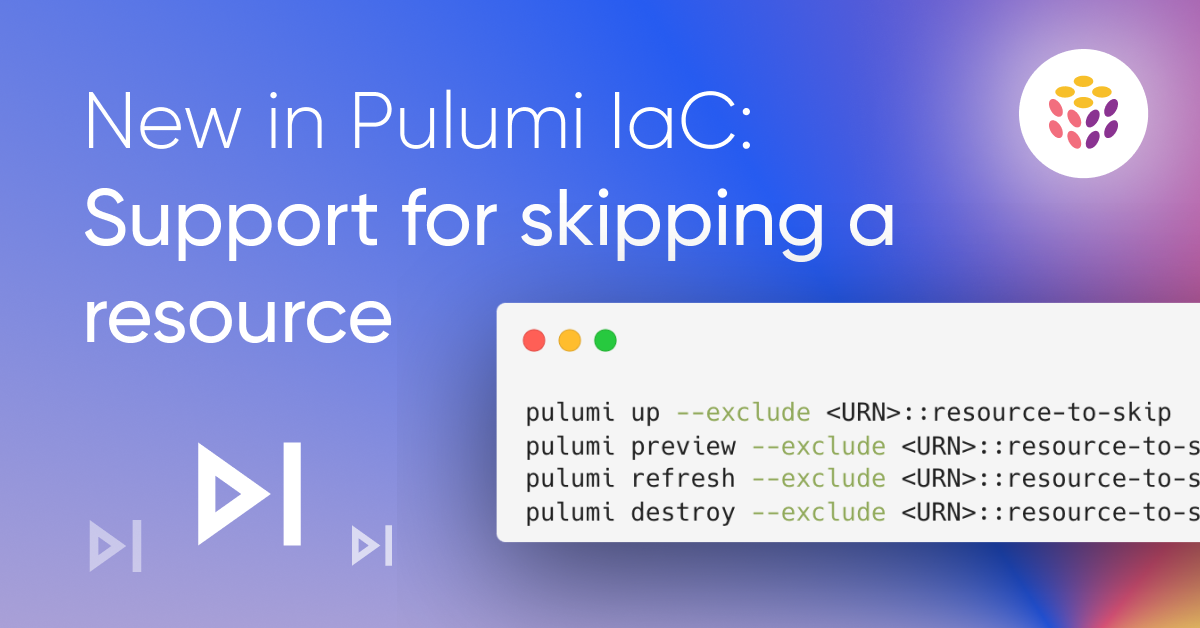
Managing large-scale infrastructure can be challenging, especially when you need to perform operations on specific subsets of your resources. Pulumi’s stack operations like pulumi up and pulumi destroy are powerful for deploying and tearing down environments, but sometimes you need more fine-grained control over which resources are affected.

Today, we’re excited to announce a highly requested feature that will save you time and reduce complexity in your workflows: the ability to exclude specific resources from stack operations using the new --exclude and --exclude-dependents flags.

These new flags complement the existing --target functionality, giving you powerful options whether you want to focus on a small subset of resources or exclude just a few from larger operations. No more workarounds or custom scripts to achieve selective deployments!

Read more →