Posts Tagged kubernetes

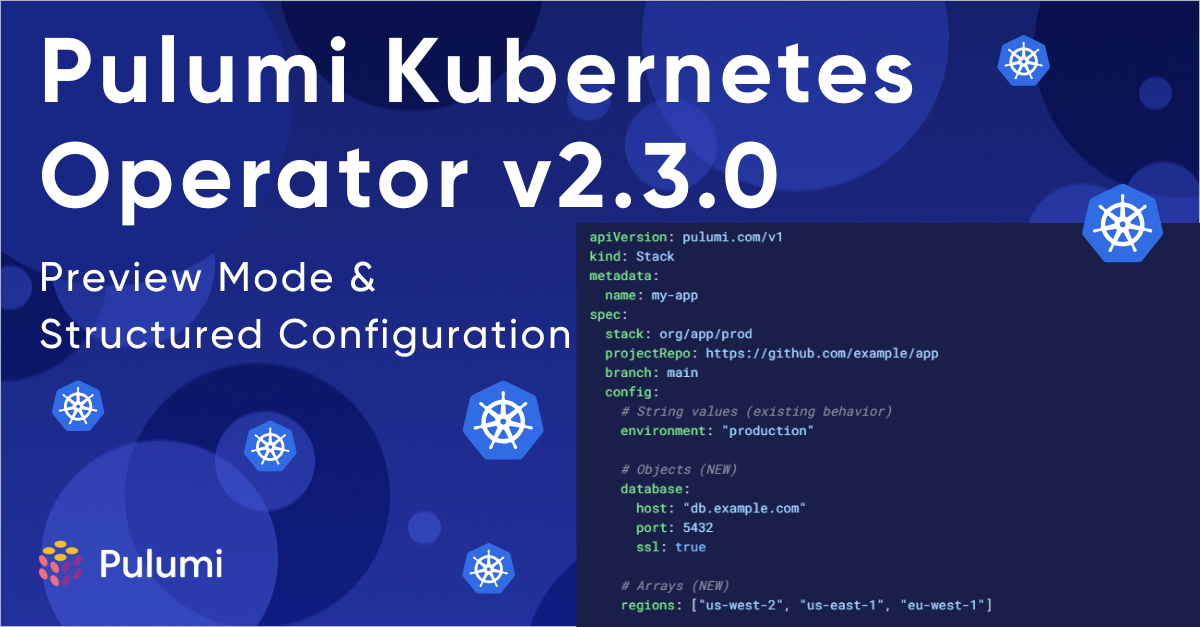
Pulumi Kubernetes Operator v2.3.0: Preview Mode and Structured Configuration

Pulumi Kubernetes Operator v2.3.0: Preview Mode and Structured Configuration

We’re excited to announce the release of Pulumi Kubernetes Operator v2.3.0, introducing two powerful capabilities that enhance GitOps workflows: preview mode for validating infrastructure changes before deployment, and structured configuration support for managing complex data types. Building on the success of the v2.0 GA release, this update addresses long-standing community requests while maintaining full backwards compatibility. These features enable safer, more sophisticated infrastructure management patterns for platform engineering teams.

Read more →

Beyond YAML in Kubernetes: The 2026 Automation Era

Beyond YAML in Kubernetes: The 2026 Automation Era

Kubernetes continues to evolve, powering not only applications but entire AI and ML systems across clouds, edges, and enterprises. By 2026, DevOps engineers, SREs, cloud engineers, and platform teams face growing pressure to deliver faster, smarter, and more secure infrastructure at scale.

Kubernetes automation is entering a new era where infrastructure as code, policy enforcement, and AI-driven orchestration work together to manage cloud environments intelligently.

Pulumi’s 2025 advancements, including Pulumi Kubernetes Operator 2.0 GA, new Kubernetes best practices playbooks, Pulumi Neo for AI assisted infrastructure management, and Policy Automation, set the foundation for a new era of Kubernetes automation that extends across every role involved in managing modern infrastructure.

Read more →

Most Effective Infrastructure as Code (IaC) Tools

Most Effective Infrastructure as Code (IaC) Tools

Infrastructure as Code (IaC) has evolved beyond simple automation into a fundamental shift toward applying software engineering practices to infrastructure management. In 2025, leading organizations aren’t just provisioning infrastructure—they’re treating it as software, complete with testing, version control, code reviews, and continuous integration.

Read more →

Platform Engineering Buffet at SEITENBAU

Platform Engineering Buffet at SEITENBAU

SEITENBAU GmbH faced a unique challenge - building a platform for 20+ independent projects, each with different tech stacks, deployment targets, and operational models. Instead of forcing standardization, they built an infrastructure buffet using Pulumi.

Read more →

AI/ML on Kubernetes: Deploying Models with Pulumi on Google Cloud

AI/ML on Kubernetes: Deploying Models with Pulumi on Google Cloud

Kubernetes has transformed cloud infrastructure by enabling scalable, containerized applications. While it initially gained traction for managing web applications and microservices, its capabilities now extend to AI/ML workloads, making it the go-to platform for data scientists and machine learning engineers.

Running AI/ML workloads on Kubernetes presents unique challenges, including:

  • Specialized hardware requirements (e.g., GPUs, TPUs)
  • Scalability for model training and inference
  • Complex data pipelines that integrate various cloud services
  • Infrastructure automation for seamless deployment

Google Cloud Kubernetes (GKE) provides a robust foundation for AI/ML workloads, but managing infrastructure manually can be cumbersome. This is where Pulumi comes in—enabling Infrastructure as Code (IaC) to automate and simplify AI/ML infrastructure on Kubernetes.

Read more →

Why Every Cloud Engineer Needs Pulumi ESC for Secrets Management

Why Every Cloud Engineer Needs Pulumi ESC for Secrets Management

Managing secrets is one of the most critical responsibilities in cloud engineering. Secrets like API keys, database credentials, and encryption tokens are the backbone of secure and seamless cloud operations. Yet they are so often an afterthought. They get replicated across cloud-specific secrets managers and stuffed in GitHub secrets, compromising security for the sake of simplicity. ¿Por que no los dos? Why can’t secrets management be secure and simple?

Enter Pulumi ESC (Environments, Secrets, and Configuration)—a breakthrough in taming secrets sprawl and streamlining configuration management across infrastructure. Let’s explore why Pulumi ESC is a necessity for cloud engineers, helping make secrets management secure while keeping it simple.

Read more →

Kubernetes Best Practices I Wish I Had Known Before
Kubernetes Best Practices I Wish I Had Known Before

Kubernetes has undeniably transformed the way we build, ship, and run applications. But let’s be honest, getting started with Kubernetes can feel like climbing Mount Everest in flip-flops.

As a cloud-native citizen and Kubernetes enthusiast, I’ve learned the hard way that there are a bunch of “wish I had known that earlier” best practices. They could have saved me time, money, and headaches.

Read more →

Master Kubernetes Secrets with Pulumi ESC + Secrets Store CSI Driver

Master Kubernetes Secrets with Pulumi ESC + Secrets Store CSI Driver

Welcome to the second blog post of the Pulumi ESC and Kubernetes secrets series. If you haven’t had the chance to read the first blog post, go ahead and read it here.

In the previous blog post, we have learned how to manage secrets with Pulumi ESC and the External Secrets Operator. While the External Secrets Operator is a great tool to manage secrets in a cloud-native way, it still creates Kubernetes secrets in the cluster. Depending on your security requirements, you might want to avoid the use of Kubernetes secrets in your cluster at all. This is the point where you hit the limits of the External Secrets Operator.

Read more →